 GitBucket
 Fanfarm User
authored
on 12 Sep
Fanfarm User
authored
on 12 Sep
|
|||
|---|---|---|---|
| .. | |||
| dist | 7 months ago | ||
| CHANGELOG.md | 7 months ago | ||
| LICENSE.md | 7 months ago | ||
| README.md | 7 months ago | ||
| browser.js | 7 months ago | ||
| package.json | 7 months ago | ||
CSS Has Pseudo [<img src="http://jonathantneal.github.io/js-logo.svg" alt="" width="90" height="90" align="right">][CSS Has Pseudo]

[CSS Has Pseudo] lets you style elements relative to other elements in CSS,
following the [Selectors Level 4] specification.
a:has(> img) {
  /* style links that contain an image */
}

h1:has(+ p) {
  /* style level 1 headings that are followed by a paragraph */
}

section:not(:has(h1, h2, h3, h4, h5, h6)) {
  /* style sections that don’t contain any heading elements */
}

body:has(:focus) {
  /* style the body if it contains a focused element */
}
Usage
From the command line, transform CSS files that use :has selectors:
npx css-has-pseudo SOURCE.css --output TRANSFORMED.css
Next, use your transformed CSS with this script:
<link rel="stylesheet" href="TRANSFORMED.css">
<script src="https://unpkg.com/css-has-pseudo/dist/browser-global.js"></script>
<script>cssHasPseudo(document)</script>
⚠️ Please use a versioned url, like this : https://unpkg.com/css-has-pseudo@3.0.0/dist/browser-global.js
Without the version, you might unexpectedly get a new major version of the library with breaking changes.
⚠️ If you were using an older version via a CDN, please update the entire url.
The old URL will no longer work in a future release.
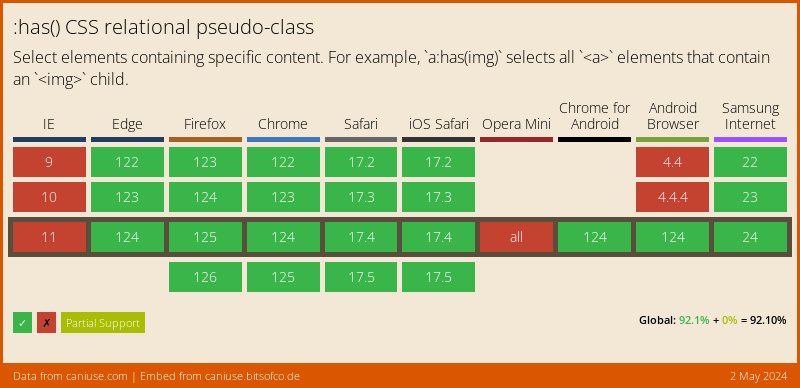
That’s it. The script is 765 bytes and works in most browser versions, including
Internet Explorer 11. With a [Mutation Observer polyfill], the script will work
down to Internet Explorer 9.
See README BROWSER for more information.
How it works
The PostCSS plugin clones rules containing :has,
replacing them with an alternative [:has] selector.
body:has(:focus) {
  background-color: yellow;
}

section:not(:has(h1, h2, h3, h4, h5, h6)) {
  background-color: gray;
}

/* becomes */

body[\:has\(\:focus\)] {
  background-color: yellow;
}

body:has(:focus) {
  background-color: yellow;
}

section[\:not-has\(h1\,\%20h2\,\%20h3\,\%20h4\,\%20h5\,\%20h6\)] {
  background-color: gray;
}

section:not(:has(h1, h2, h3, h4, h5, h6)) {
  background-color: gray;
}
Next, the JavaScript library adds a [:has] attribute to
elements otherwise matching :has natively.
<body :has(:focus)>
  <input value="This element is focused">
</body>